Maybe true crime documentaries have you clutching your partner’s hand when you make that nightly trip to the loo. Or maybe it’s weird internet facts and mysteries that make you spiral for hours on end.
Whatever you’re into — basically whatever gives you the chills or makes your skin crawl — this list has something for everyone.
Even just putting it together from ‘The Scary Fact’ Instagram account had us fully spooked and side-eyeing dark corners. Proceed at your own risk… and maybe keep a light on.
Bored Panda also spoke to co-directors of the Recreational Fear Lab in Denmark, Marc Malmdorf Andersen and Mathias Clasen, to understand why some people like scary stuff while others don’t.
Click here & follow us for more lists, facts, and stories.
#1
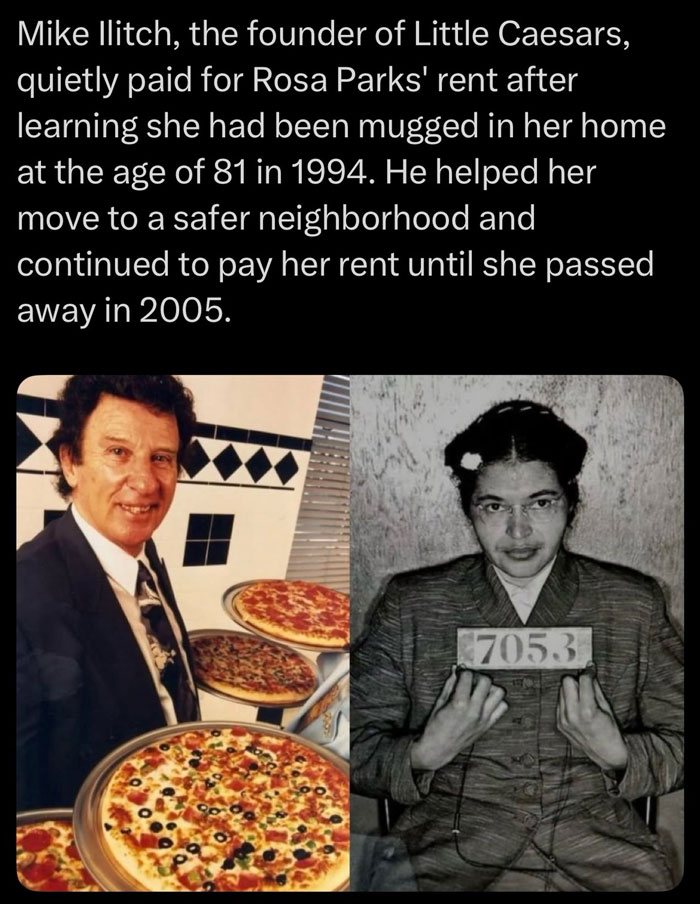
© Photo: thescaryfact
#2
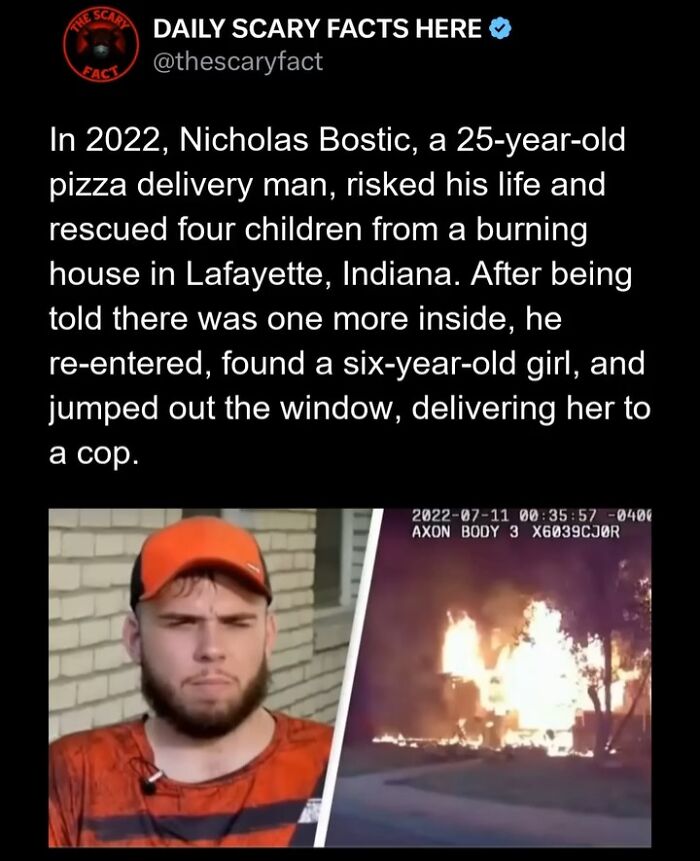
In 2022, Nicholas Bostic, a 25-year-old pizza delivery driver in Indiana, noticed a house on fire and rushed inside without hesitation. He helped four children escape before learning a sixth child was still trapped. Despite smoke and flames, he re-entered the home, found the six-year-old girl, and jumped out a window with her in his arms. He suffered injuries but saved all five children — earning national recognition for his bravery.
© Photo: thescaryfact
Logically, fear is supposed to protect us because our ancestors were out here dealing with actual, real-life threats like wild animals and hostile environments.
It is why fear usually triggers the fight-or-flight response.
Over time, we also learnt to channel this instinct into stories, and even a source of entertainment.
The earliest traces of horror go way, way back. On ancient Mesopotamian clay tablets like those that tell the story of ‘The Epic of Gilgamesh,’ one can find ghosts, ogres, demons, monstrous beasts, and even proto-zombies.
They are evidence that even early storytellers loved weaving in creepy and supernatural stuff to teach lessons and tap into the same fear instincts that still make us binge horror today.
#3
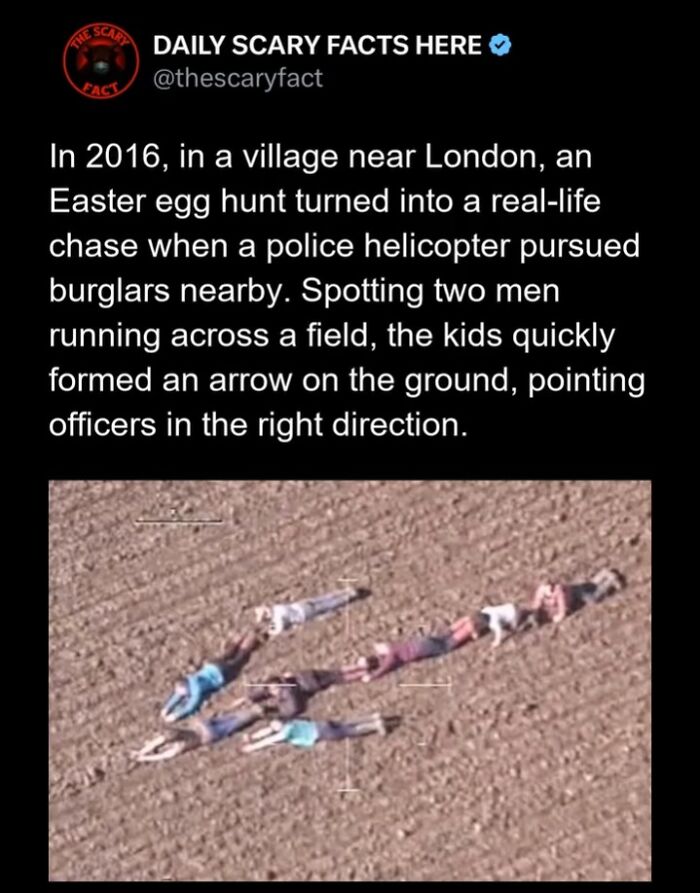
In 2016, during an Easter egg hunt near London, children noticed a police helicopter circling overhead while officers searched for burglary suspects. Spotting two men running across a nearby field, the kids quickly improvised. They formed a giant human arrow on the ground, pointing toward the fleeing suspects — guiding the helicopter’s camera to the right direction. Police later confirmed the children’s quick thinking helped locate the suspects.
© Photo: thescaryfact
Be it creepy facts, ghost stories, or full-on nightmare fuel TV shows and movies — they all basically let us face the worst fears… but from the safety of our couch, wrapped in a blanket, snacks in hand.
“People are drawn to scary content because it frightens them, but it’s not actually as weird as it sounds. Scary entertainment is not just about fear, it’s about getting pleasure from fear,” Marc Malmdorf Andersen and Mathias Clasen tell Bored Panda in an interview.
“We believe that people enjoy playing with fear, because it allows them to explore certain physiological and emotional sensations that can be hard to find elsewhere, but also, on a deeper and perhaps subconscious level, because they can learn important things about themselves and about the world, like how we respond under pressure, what we can do to cope, that sort of thing,” they add.
#4
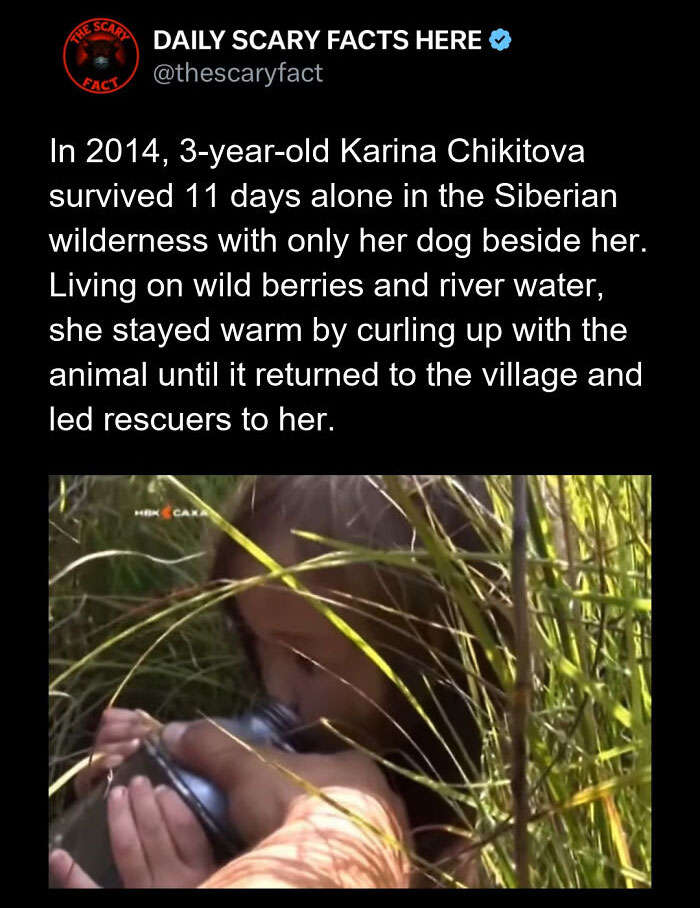
In 2014, 3-year-old Karina Chikitova survived 11 days alone in the Siberian wilderness with only her dog beside her. The idea of a child that young enduring endless isolation, cold, and hunger in such a vast and unforgiving place feels almost impossible to believe. Every hour she remained alive was a quiet fight against nature itself. She survived on wild berries and river water, and stayed warm by curling up with the dog until it returned to the village and led rescuers to her. That is what makes the story so powerful. In the middle of overwhelming wilderness, loyalty, instinct, and sheer endurance kept a small child alive against nearly impossible odds.
© Photo: thescaryfact
Be it creepy facts, ghost stories, or full-on nightmare fuel TV shows and movies — they all basically let us face the worst fears… but from the safety of our couch, wrapped in a blanket, snacks in hand.
“The paradox of horror is a very old puzzle. Even Aristotle spoke about how weird it is that we’re set up to evade and to avoid dangerous, disgusting, harmful, horrible things. Yet we feel magnetized to be in spaces where we’re in touch with disgusting, horrible, noxious, or horrifying things,” Mark Miller, a research fellow at Monash University in Australia and the University of Toronto, tells the BBC.
#5
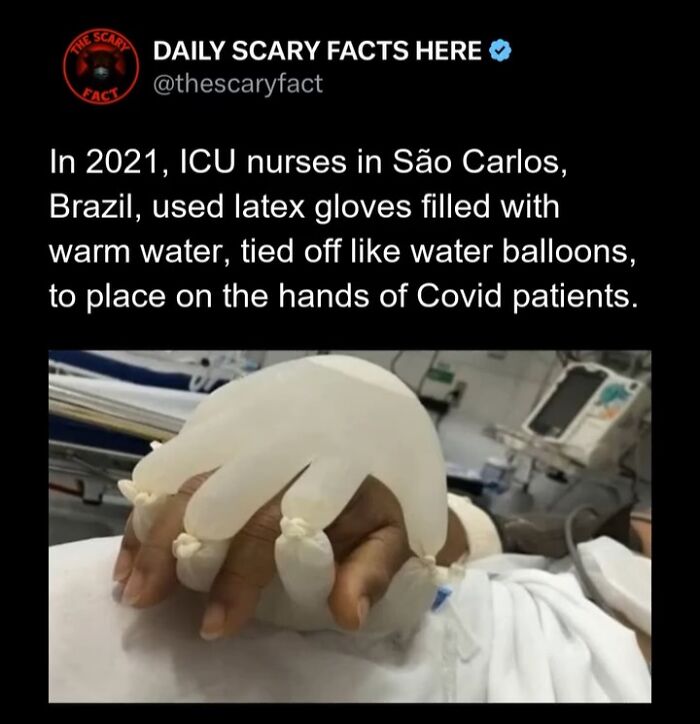
During the Covid-19 pandemic in São Carlos, Brazil, ICU nurses filled latex gloves with warm water and tied them off, placing them in patients’ hands. The makeshift devices simulated the warmth and pressure of human touch. Because strict isolation rules prevented family visits, the gesture was meant to provide emotional comfort to critically ill patients. The practice symbolized compassion during one of healthcare’s darkest periods.
© Photo: thescaryfact
Consuming scary content can make you more vigilant, Andersen and Clasen explain.
“Some people exhibit mild anxiety symptoms after exposure to frightening content, such as sleeping with the lights on, avoiding camping trips after seeing The Blair Witch Project, or staying away from the beach because of Jaws. But there is no evidence that indicate that frightening entertainment can permanently affect your mental health in a negative way.”
They add: “But you might be in for a couple bad nights’ sleep and perhaps some avoidance behavior which typically goes away in due time. With children, these effects can be more pronounced, so it advised to adhere to age guidelines when it comes to children and frightening entertainment.”
#6
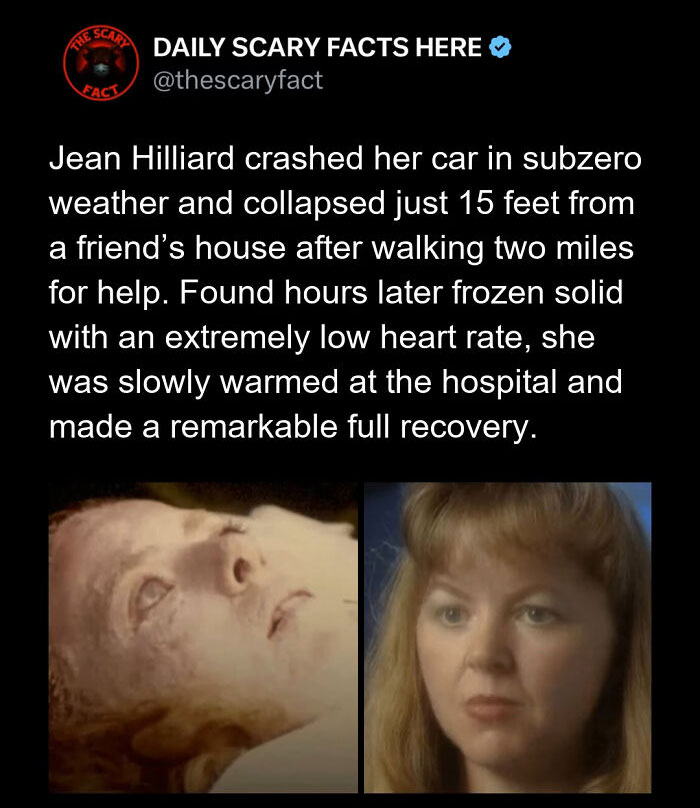
Jean Hilliard crashed her car in subzero weather and walked two miles trying to find help before collapsing just 15 feet from a friend’s house. So close to safety, she fell into the freezing cold and was left there for hours, her body locked in conditions that should have made survival impossible. It reads less like reality and more like something out of a nightmare. When she was finally found, she was frozen solid and her heart rate was extremely low. At the hospital, doctors slowly warmed her, and against all odds she made a full recovery. What makes the story so haunting is that she stood on the edge of death in the most unforgiving cold imaginable, yet somehow came back.
© Photo: thescaryfact
#7
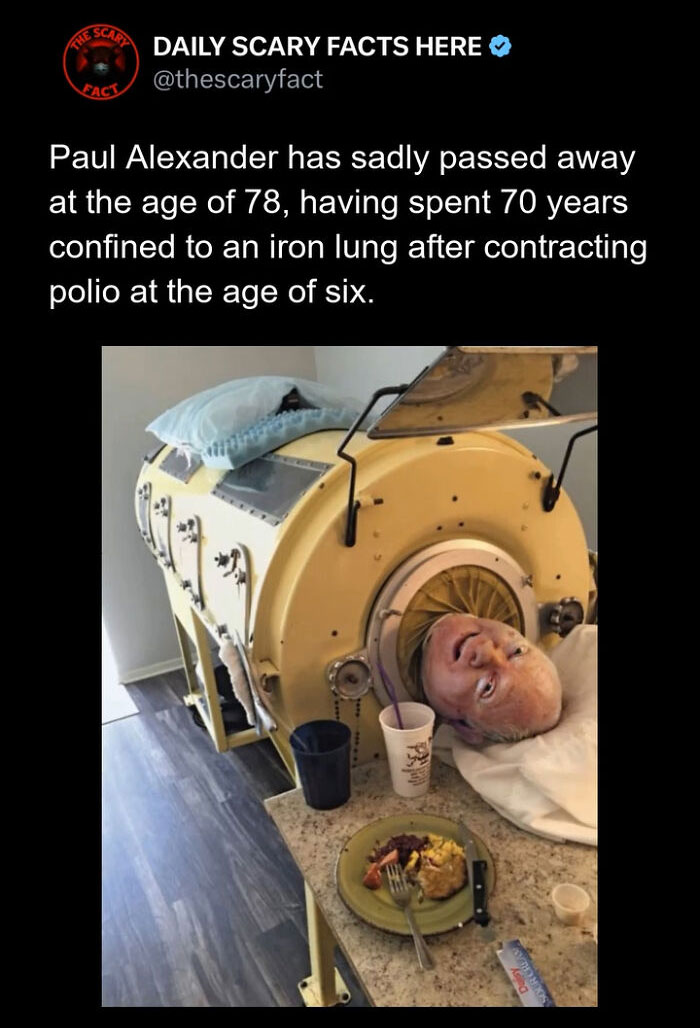
Paul Alexander passed away at 78 after spending 70 years confined to an iron lung, a machine that had kept him alive since he contracted polio at age six. Few lives have ever been so closely tied to a single machine, with every year becoming a reminder of how survival for him depended on metal, pressure, and constant endurance. What makes his story so haunting is the sheer length of time he lived this way. Decade after decade passed while the iron lung remained his world, turning childhood illness into a lifetime of confinement. His death marked the end of an existence that felt almost impossible, yet he carried it for longer than most people can even imagine.
© Photo: thescaryfact
Feeling a little bit scared in a totally controlled, no-actual-danger way is fun for a lot of people.
In a poll, about 48% of Americans said that they liked watching horror movies.
There are significant differences by age though.
Scary movies appeal more to younger people — 71% of Americans under the age of 35 say they enjoy scary movies, while just 23% of those 65 and above do.
Half of those who said they sometimes had nightmares after watching a scary movie confessed that they still enjoy watching them.
#8
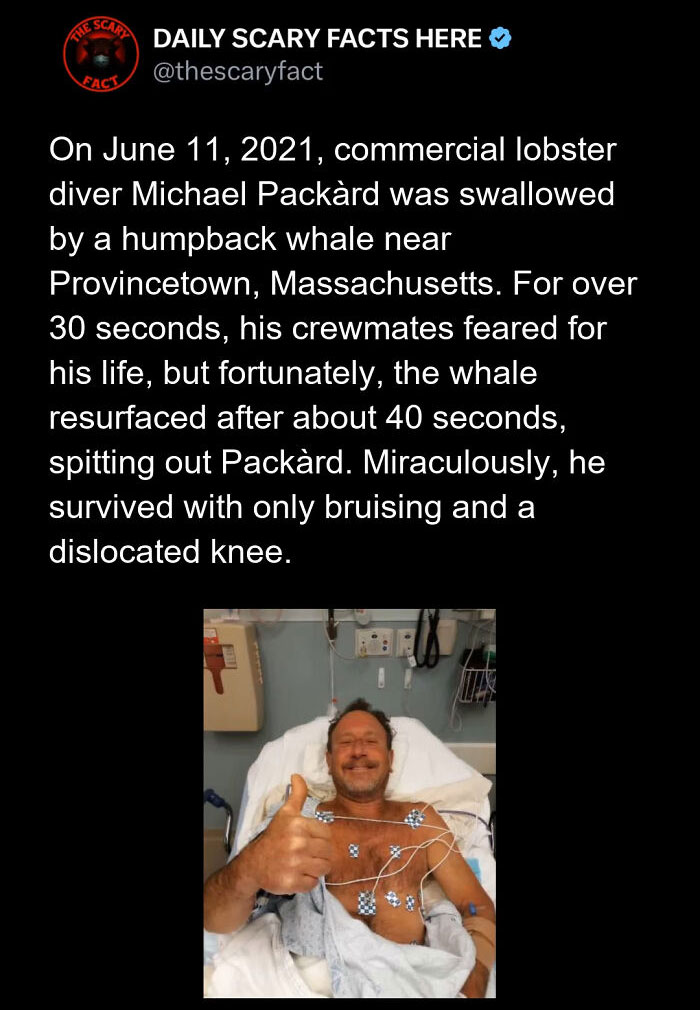
On June 11, 2021, commercial lobster diver Michael Packàrd was swallowed by a humpback whale near Provincetown, Massachusetts. For over 30 seconds, his crewmates feared they had just watched him vanish into something impossible, with no way of knowing whether he would ever come back up. After about 40 seconds, the whale resurfaced and spat him out. He survived with bruising and a dislocated knee. What makes the story so unreal is how it sounds like something from a nightmare or an old legend, yet it happened in open water to a man who lived through being trapped inside the mouth of something massive enough to erase him in an instant.
© Photo: thescaryfact
#9
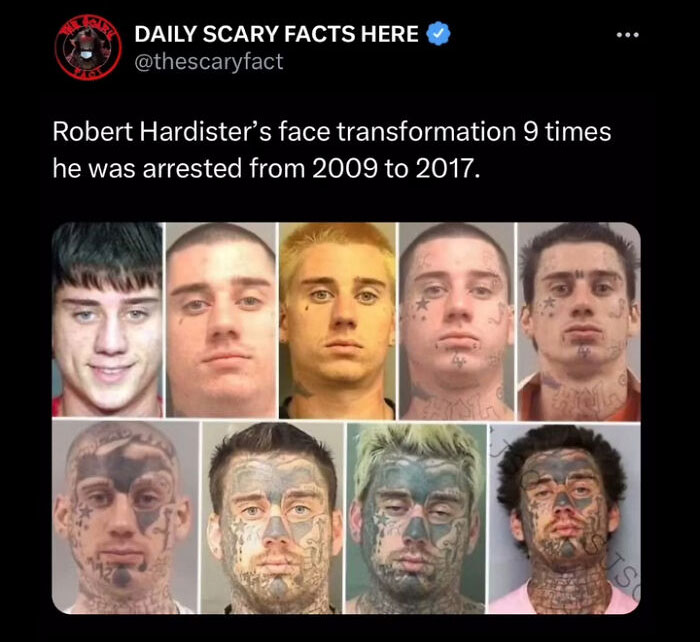
© Photo: thescaryfact
It’s not just movies, many people also actively seek out scary stories through books, podcasts and social media — be it horror, mystery, thriller, or true crime.
A 2025 study found as many as 74% of people in the UK read true crime content, making it one of the most popular scary genres.
Many of us like to casually unwind to real-life stories of m****r, deception, crime and forensic investigation.
It’s because of something called “defensive vigilance.”
Like we mentioned earlier, our brains are wired to pay attention to real danger so we can figure out how to stay safe. Reading about a m****r case or listening to a creepy true story fires up the same parts of the brain as a scary movie.
It’s curiosity about real-world danger that feels useful, not just entertaining.
#10
In 2022, Georgia college student Caitlin Jensen suffered multiple arterial dissections after a chiropractic neck manipulation. She went into cardiac arrest, had a stroke, and reportedly lost a pulse for over 10 minutes before being revived. She survived but was left unable to speak and with limited movement. The case reignited debate about the rare but serious risks of cervical manipulations and vascular injury.
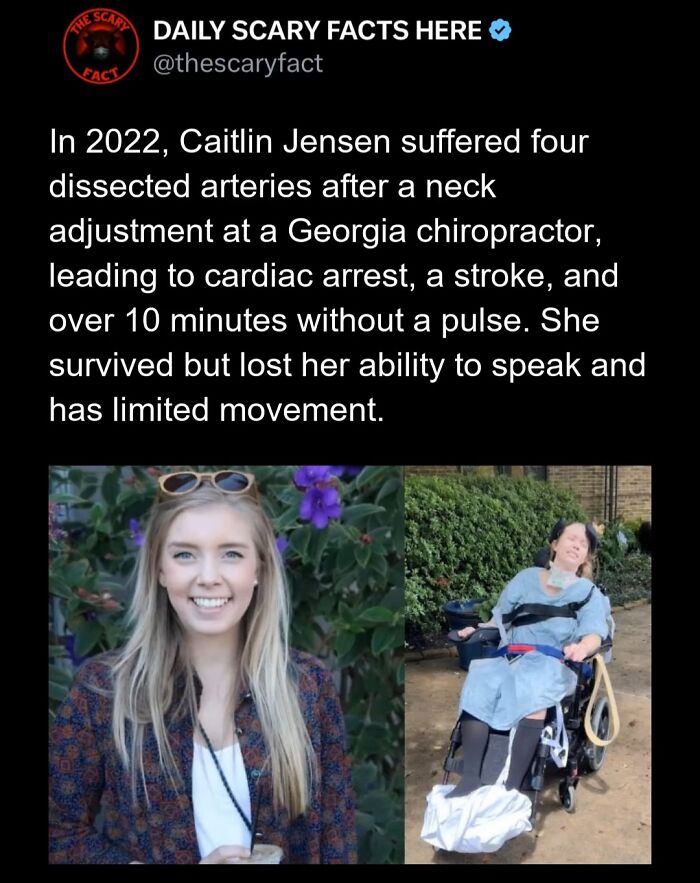
© Photo: thescaryfact
#11
Richard Anthony “Richard A.” Jones was wrongfully convicted after a 1999 purse-snatching/robbery case near a Kansas City–area Walmart, based largely on eyewitness identification rather than physical evidence. He maintained his innocence for years, and while serving a 19-year sentence, he kept insisting the real suspect was someone who looked nearly identical to him. The turning point came when inmates started confusing Jones for another prisoner, Ricky (Richard) Amos, and Jones reported that “double” to the University of Kansas School of Law’s Project for Innocence. Investigators tracked Amos down, and the case unraveled—Jones ultimately walked free in 2017 after spending nearly 17 years locked up.
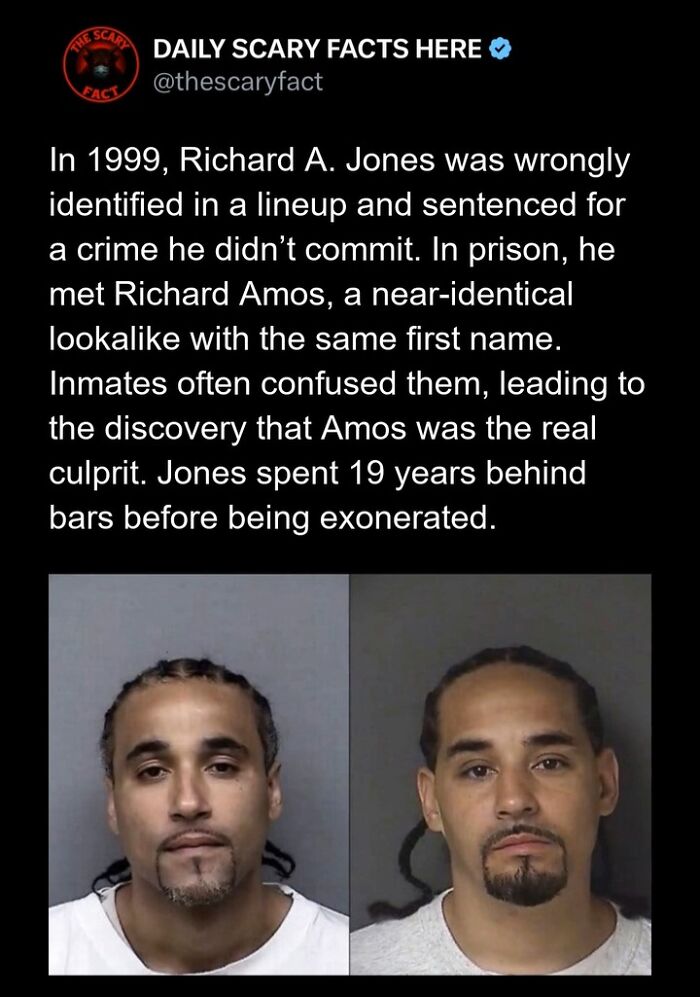
© Photo: thescaryfact
Feeling a little bit scared in a totally controlled, no-actual-danger way is fun for a lot of people.
In a poll, about 48% of Americans said that they liked watching horror movies.
There are significant differences by age though.
Scary movies appeal more to younger people — 71% of Americans under the age of 35 say they enjoy scary movies, while just 23% of those 65 and above do.
Half of those who said they sometimes had nightmares after watching a scary movie confessed that they still enjoy watching them.
#12
Robert DuBoise’s life changed dramatically over the span of nearly four decades. At the age of 18, he was arrested for a crime he did not commit. This wrongful arrest led to his conviction and imprisonment, a harrowing experience that kept him behind bars for 37 years. During his time in prison, DuBoise maintained his innocence, but it wasn’t until advancements in DNA technology provided a new avenue for justice that his case was re-examined. At the age of 56, DuBoise was finally exonerated and freed from prison, thanks to DNA evidence that proved his innocence. His release marked a moment of profound relief and a new beginning, highlighting the critical importance of forensic science in correcting miscarriages of justice. The contrast between the young man unjustly incarcerated and the mature man freed by the truth underscores the significant impact of wrongful convictions on individuals’ lives.
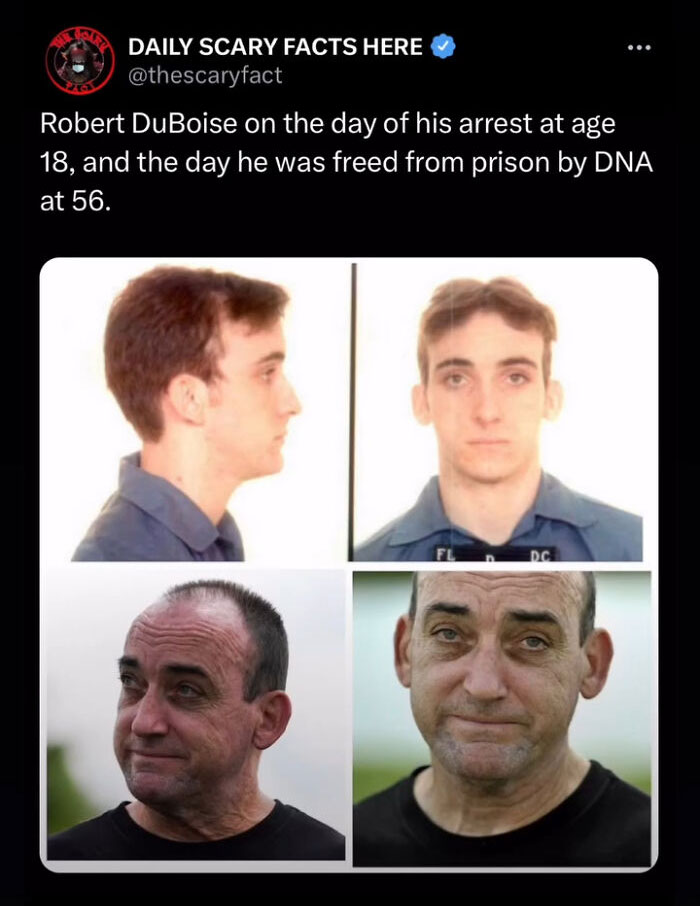
© Photo: thescaryfact
A survey of younger readers found that up to 56% read horror and 65% read mystery/thriller genres.
Studies also show that if your interest in scary stuff started when you were a child, chances are you still can’t get enough.
At least 60% of Americans said that watching your first scary movie at a slumber party is a rite of passage.
#13
Abby and Brittany Hensel are among the most well-known conjoined twins in the world. Born in 1990 and joined at the torso, they share one body but have two separate heads, hearts, stomachs, and spinal cords. Despite their rare anatomy, they have lived remarkably independent lives — learning to coordinate movement, drive a car, and complete everyday tasks through constant teamwork. When they attended college, they reportedly had to pay two separate tuition fees, reflecting their status as two individuals academically. However, as adults working as teachers, they receive one shared salary, which has sparked discussion about how workplaces and institutions handle unique medical and legal situations. Their story continues to challenge perceptions about identity, independence, and how society defines individuality.

© Photo: thescaryfact
Several experts believe that watching and reading scary stories can actually train our brains to handle fear. It can even help forge resilience, especially in kids.
“The world can be a scary place – children will get into situations where they’re told off by teachers, or fall out with friends. Knowing how to confront fear is a good thing,” psychologist Emma Kenny told The Guardian.
“Risk and fear are something we need in childhood. We know that people who take risks, in the long term, do better than those who don’t … And how can you feel safe and secure until you know what it’s like to be afraid? Anything that gives you a wide range of emotions in a safe and controlled environment is great,” Kenny added.
#14
Japanese soldier Ishinosuke Uwano was presumed dead after World War II and officially declared deceased decades later. In reality, he had settled in Ukraine, married, and started a family. In 2006, after more than 60 years, he returned to Japan at age 83, reuniting with surviving relatives who had believed he died in the war. His story stunned both nations.
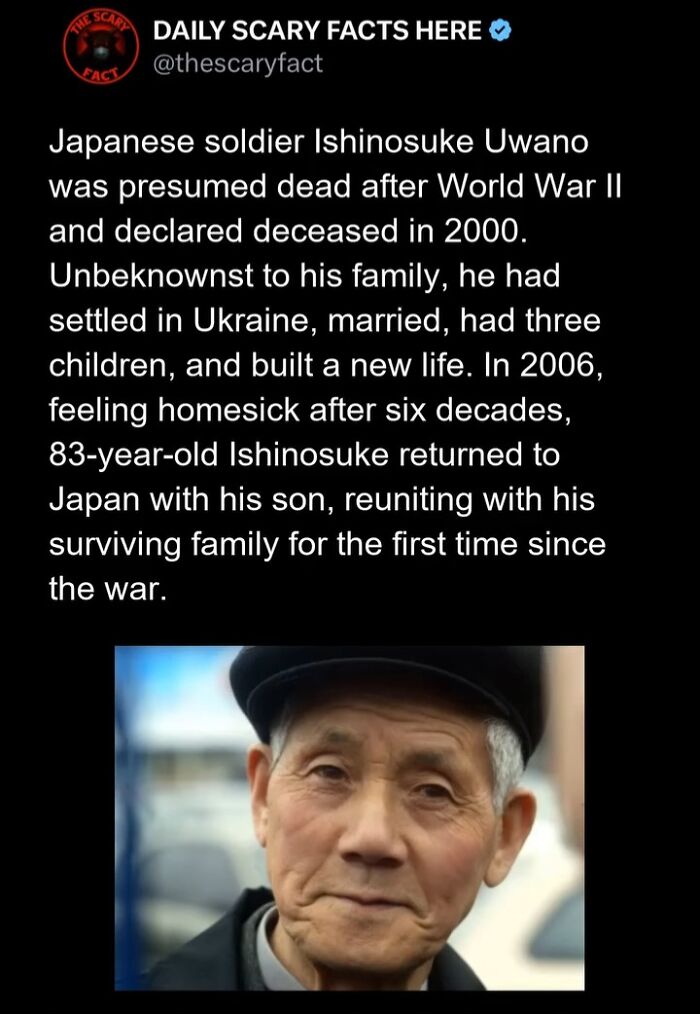
© Photo: thescaryfact
#15
In 2013, Belgian woman Sabine Moreau set out to pick up a friend in Brussels — a trip under 90 miles — but blindly followed her GPS when it misdirected her. She ended up driving nearly 900 miles, crossing five countries, before reaching Croatia. She later said she ignored road signs because she trusted the GPS instructions. Her son had already reported her missing. The story went viral as one of the most extreme examples of blind reliance on navigation tech.
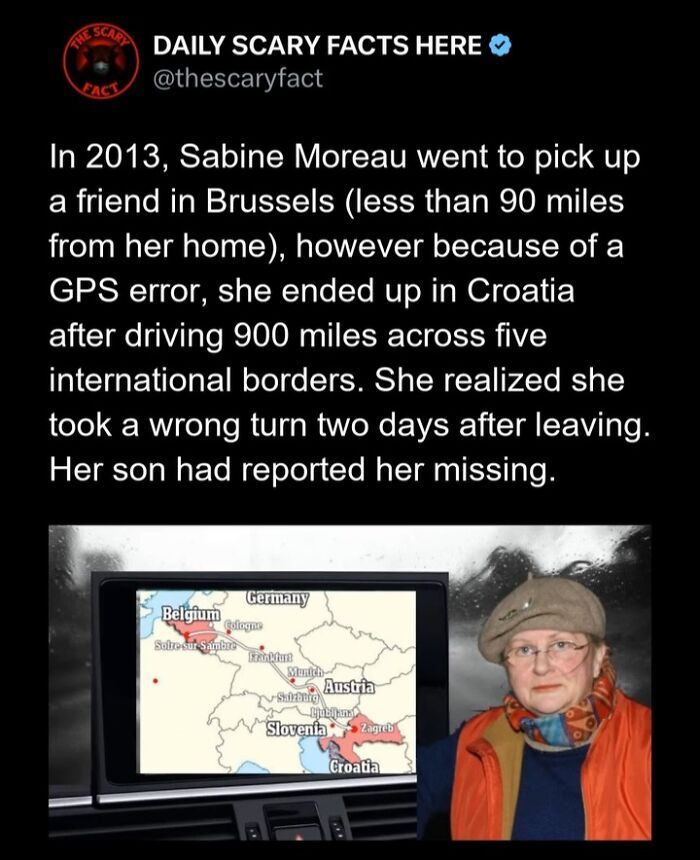
© Photo: thescaryfact
Did you know that horror can also help soothe your anxiety?
Experts say that anxiety can make people blow threats out of proportion or doubt their own ability to handle them. Watching or reading scary stuff, though, can help put things back in perspective.
People who seek this thrill as a way to deal with real life have been dubbed “dark copers” by researchers.
“Dark copers use horror as an instrument with which to navigate a world that they perceive to be scary. As humans, we’re constantly forecasting. In a sense, horror is just like a formalized worst-case scenario that’s a very natural product of the way we cope,” says Mathias Clasen, co-founder of the Recreational Fear Lab at Aarhus University in Denmark.
According to the lab’s findings, many people derive great enjoyment, self-discovery, and personal growth from this genre.
A study also found that fans of horror films showed greater resilience at the height of the Covid-19 pandemic.
#16
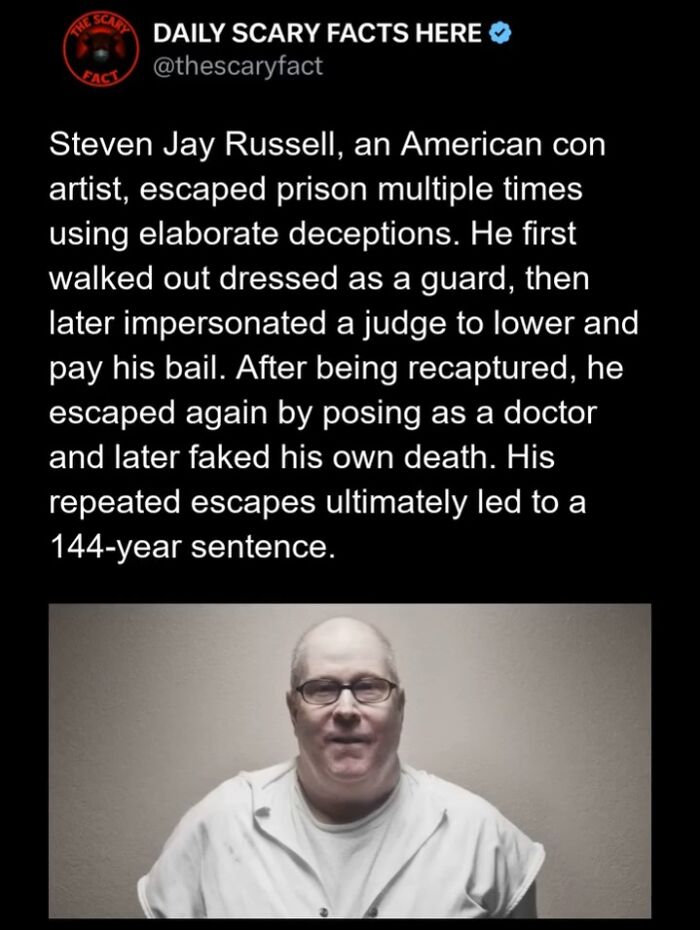
© Photo: thescaryfact
#17
That strong “chlorine” smell at public pools isn’t actually chlorine. Pure chlorine has very little odor. The smell comes from chloramines, chemicals formed when chlorine reacts with nitrogen-based contaminants like urine, sweat, and body oils. When urea breaks down into ammonia and mixes with chlorine, chloramines are produced — and they smell strong while being far less effective at disinfection. Ironically, a properly maintained pool should smell almost neutral. A strong odor usually means the pool is dirty, not clean.
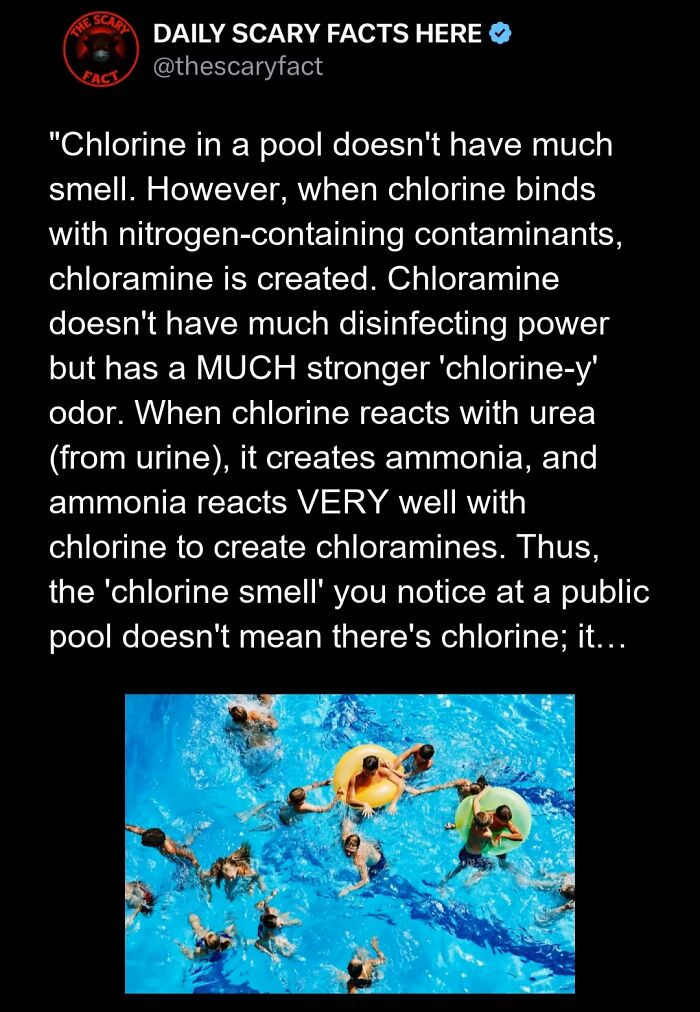
© Photo: thescaryfact
#18
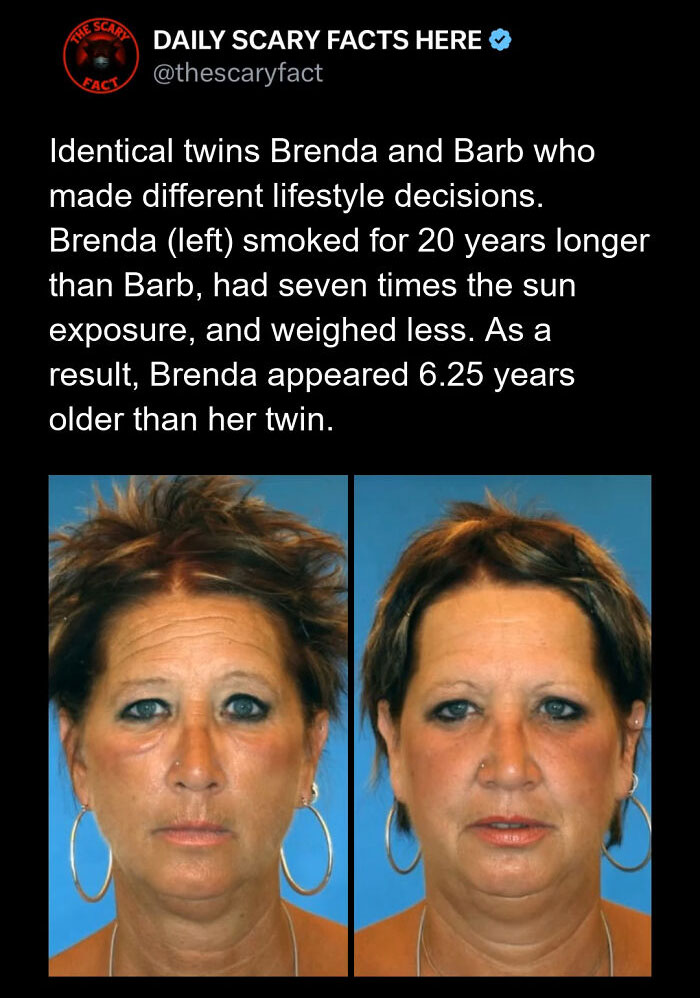
© Photo: thescaryfact
It’s not just the dark copers; experts have divided horror fans into two other categories as well.
There are your adrenaline junkies, the ones who thrive on the heart-pounding rush. Jump scares or sounds, and even suspenseful moments, make them feel alive.
Then there are white knucklers. They don’t love being scared while it’s happening, but they love the feeling of conquering that fear.
Making it through a haunted house or finishing a scary book gives them a sense of accomplishment and even a little insight about themselves.
#19
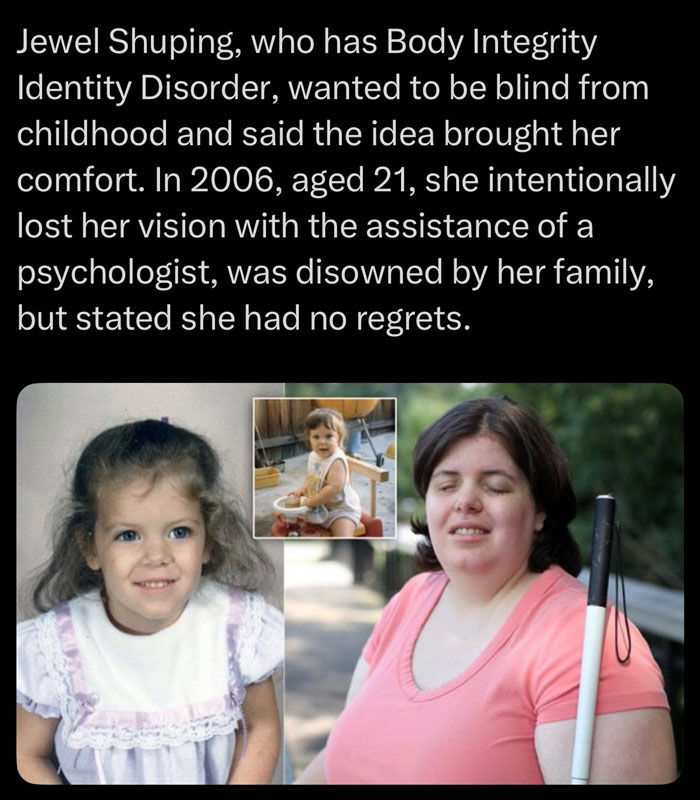
© Photo: thescaryfact
#20
News reports in early 2025 said Onijah Andrew Robinson traveled to Pakistan to meet a 19-year-old she met online, but the relationship collapsed under family pressure. She was filmed giving press-style statements and reportedly remained in the airport area for days while her situation spiraled into a visa/overstay issue. She then went viral after demanding large sums of money—famously saying she wanted $100,000 and claiming she would “rebuild” the country. The story spread widely as an example of online relationships, misinformation, and escalation in public view.
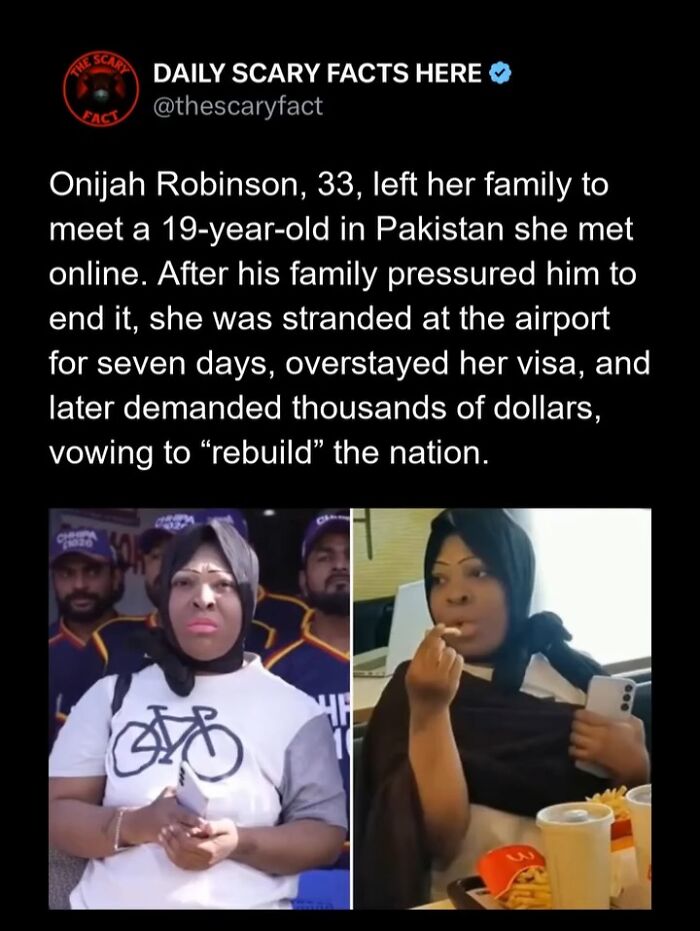
© Photo: thescaryfact
You Might Also Like: 45 wholesome posts from men that redefine masculinity
Comments are closed, but trackbacks and pingbacks are open.